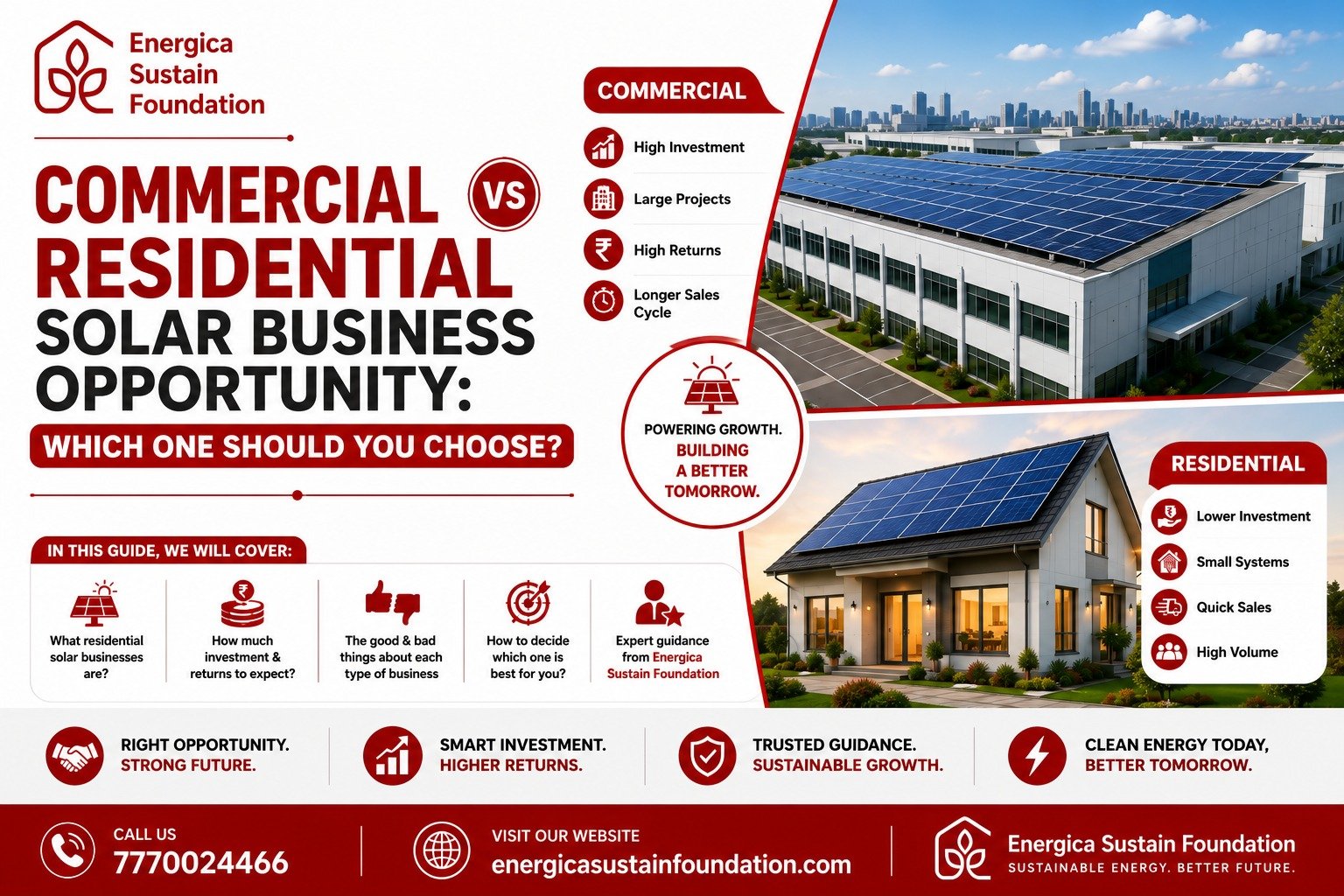
The solar market in India is growing fast. It is used in homes, offices, factories, and farms. If you want to start a solar business opportunity, you have to decide which kind of customers you want to work with: commercial or residential. Both paths can be highly profitable, but they require different starting capital, sales cycles, and operational speeds. Choosing the wrong one for your resource profile can slow your growth down, while choosing the right one will help you build a steady, scalable business.
In this guide, we will cover:
- What residential and commercial solar businesses are
- Investment comparisons and starting capital requirements
- The sales cycle and decision-making process differences
- Profit margins, government support, and pros & cons of each segment
- How to decide which model is best for your entrepreneurship journey
1. What Is a Residential Solar Business Opportunity?
A residential solar business installs solar power systems on the rooftops of individual homes. Key characteristics of this model include:
- System sizing: Typically ranging from 1 kW to 10 kW.
- Target customers: Homeowners looking to lower their monthly electricity bills.
- Government incentives: Customers qualify for direct central and state subsidies (like PM Surya Ghar).
- Project duration: Simple, standardized, and fast installation projects (completed in 1-2 days).
This type of business is all about high volume—selling many small systems to a large pool of homeowners.
2. What Is a Commercial Solar Business Opportunity?
A commercial solar business installs solar energy systems for businesses, factories, offices, warehouses, hospitals, and educational institutions. Key characteristics include:
- System sizing: Ranging from 10 kW to 1 MW or more.
- Target customers: Corporate entities, manufacturers, hospitals, and office parks seeking utility savings.
- Project scope: Highly customized, technically complex projects that require detailed site engineering, load analysis, and regulatory approvals.
- Project duration: Longer installation timelines, often extending over weeks or months.
This type of business is focused on high-value contracts—selling fewer systems, but at much larger scales and values.
3. Investment Comparison: Residential vs Commercial
The capital required to start and sustain operations varies significantly between these two models.
Residential Solar Business
- Starting Capital: Approximately ₹3–8 lakhs.
- Speed to Market: You can launch and start executing deals very quickly because projects are small, standardized, and cash cycles are fast.
- Volume requirement: Since individual project profit is smaller in absolute terms, you need to maintain a steady flow of sales to generate substantial revenue.
Commercial Solar Business
- Starting Capital: Approximately ₹10–25 lakhs or more.
- Speed to Market: Launching is slower. You need working capital to fund detailed feasibility plans, structural engineering designs, and technical reviews during long negotiation periods.
- High returns per deal: A single successful commercial project can generate substantial revenue and fund your business for several months.
4. Sales Cycle and Decision-Making Process
Understanding how decisions are made and how long deals take to close is critical for your cash flow management.
| Factor | Residential Solar Projects | Commercial Solar Projects |
|---|---|---|
| Who Makes the Decision? | Homeowner | Business Owner, Director, or Facility Manager |
| Sales Cycle Duration | 2–4 Weeks | 2–6 Months |
| Decision Makers Involved | 1–2 People | Multiple Stakeholders (Management, Finance, Technical Team) |
| Project Value | Small Investment | High-Value Investment |
| Number of Sales Required | Many Small Projects | Few Large Projects |
| Sales Approach | Quick decision with high lead volume | Longer evaluation with detailed technical and financial discussions |
| Customer Relationship | Short-term transaction | Long-term business relationship and recurring opportunities |
| Revenue Potential | Lower profit per project | Higher profit from each successful project |
Residential sales happen fast but require you to find new customers constantly to feed your installation pipeline. Commercial sales take longer but yield high revenue from a single transaction, allowing you to focus on building long-term business relationships and secondary support contracts.
5. Profit Margins: Which One Earns More?
Profitability depends on how you measure margins versus project volumes:
- Residential systems: Usually yield higher percentage profit margins of 20–25% per project, but the absolute profit amount is smaller due to smaller system costs.
- Commercial systems: Usually yield lower percentage margins of 15–20%, but the absolute profit is much larger because the project costs run into tens of lakhs or crores.
In short, residential is about making smaller profits frequently, while commercial is about secure, high-value profits less often.
6. Government Help for Each Segment
Both models benefit from supportive government policies, but the mechanisms differ:
- Residential: Homeowners receive direct upfront financial subsidies (like PM Surya Ghar), making it highly attractive and easier to sell.
- Commercial: Businesses receive accelerated depreciation benefits, tax exemptions, and open access credits, helping them reduce corporate tax liabilities and offset investment costs.
7. Good and Bad Things About Residential Solar Business
Pros (Good things):
- Lower initial capital required to start.
- Quick business setup and rapid sales cycles.
- Simple and standardized installation process.
- High consumer demand fueled by attractive government subsidies.
Cons (Bad things):
- Constant need to generate new leads and find new customers.
- Smaller absolute profit per project.
- Residential customers are highly price-sensitive.
- Fierce local competition from smaller, independent installers.
8. Good and Bad Things About Commercial Solar Business
Pros (Good things):
- High absolute revenue and profit from a single deal.
- Long-term business relationships with recurring service contract opportunities.
- Commercial clients are less price-sensitive and focus more on quality, ROI, and technical compliance.
- Larger barrier to entry means less direct local competition.
Cons (Bad things):
- Requires substantial starting capital and working capital.
- Long and complicated sales cycles (2 to 6 months).
- Requires advanced project management, engineering expertise, and corporate negotiation skills.
- Smaller pool of potential customers.
9. Which One Should You Choose?
When deciding which path to take, ask yourself these diagnostic questions:
- How much capital do you have? If your starting budget is limited, starting in the **residential** sector is highly recommended.
- Do you have project management experience? If you have experience managing engineering teams or complex corporate sales, the **commercial** sector is a great fit.
- How fast do you need cash flow? If you need to make revenue immediately to sustain your business, start with **residential** to get quick wins.
- What is your local market like? Auditing your territory is key. If you are surrounded by residential suburbs, focus on home solar. If you operate in industrial zones or MIDC belts, focus on commercial systems.
Many successful entrepreneurs start in the **residential** sector to build capital, establish their local brand, and then expand into the **commercial** sector as they grow their team and technical capabilities.
10. How Energica Sustain Foundation Can Help
Choosing between residential and commercial is a strategic business decision. It is not just about preference; it is about aligning your capital resources with your local market demand. Energica Sustain Foundation helps entrepreneurs:
- Analyze your local market and decide which business model fits you best.
- Perform project feasibility studies and structural site evaluations.
- Provide technical training and capacity building for your sales and installation teams.
- Bridge the gap between technical design and financial viability, ensuring your projects are built for maximum ROI.
Get help with choosing your business model, planning your investment cash flow, and mastering solar technical installation standards.
Frequently Asked Questions
Which one is more profitable: a residential or commercial solar business?
Commercial projects generate much larger absolute profits because of the high project values, even though their profit margin percentage (15–20%) is slightly lower. Residential projects offer higher margin percentages (20–25%) but lower absolute profit per deal. Both can be highly profitable depending on your sales volume.
Which business model needs less money to start?
A residential solar business needs significantly less starting capital, typically ranging from ₹3–8 lakhs, making it perfect for beginners and small business owners.
Can I start with residential and transition to commercial solar later?
Yes. Many entrepreneurs start with residential installations to generate quick cash flow, build technical credibility, and establish their brand, and then move into commercial projects once they have accumulated capital and experience.
Which segment has a faster sales cycle?
Residential solar projects sell much faster, typically closing in 2–4 weeks. Commercial projects involve multiple stakeholders and require detailed evaluations, resulting in sales cycles of 2–6 months.
Do government subsidies apply to both residential and commercial solar?
Upfront financial subsidies (like PM Surya Ghar) apply directly to residential installations to make them affordable for homeowners. Commercial projects do not receive upfront capital subsidies but benefit from tax breaks, accelerated depreciation, and open access policies.
What skills do I need to run a commercial solar business?
Commercial projects require robust structural engineering knowledge, project management expertise, corporate sales capabilities, and familiarity with local grid compliance and regulatory approvals.
Which model is recommended for beginners in the solar industry?
The residential solar business model is highly recommended for beginners because of its lower start-up cost, simpler installation process, faster sales cycle, and high market demand driven by subsidies.
How can the Energica Sustain Foundation help me start my solar business?
Energica Sustain Foundation can help you evaluate your local market, perform feasibility studies, plan your investment cash flow, and provide technical training so you can build a compliant and profitable solar business.
Build the Right Solar Business for Your Goals
Whether you choose residential or commercial solar, aligning your business model with your local market is the key to success. Connect with the Energica Sustain Foundation today for expert business setup support, feasibility analysis, and technical training.
Connect with Energica Sustain Foundation (www.energicasustainfoundation.com) today.