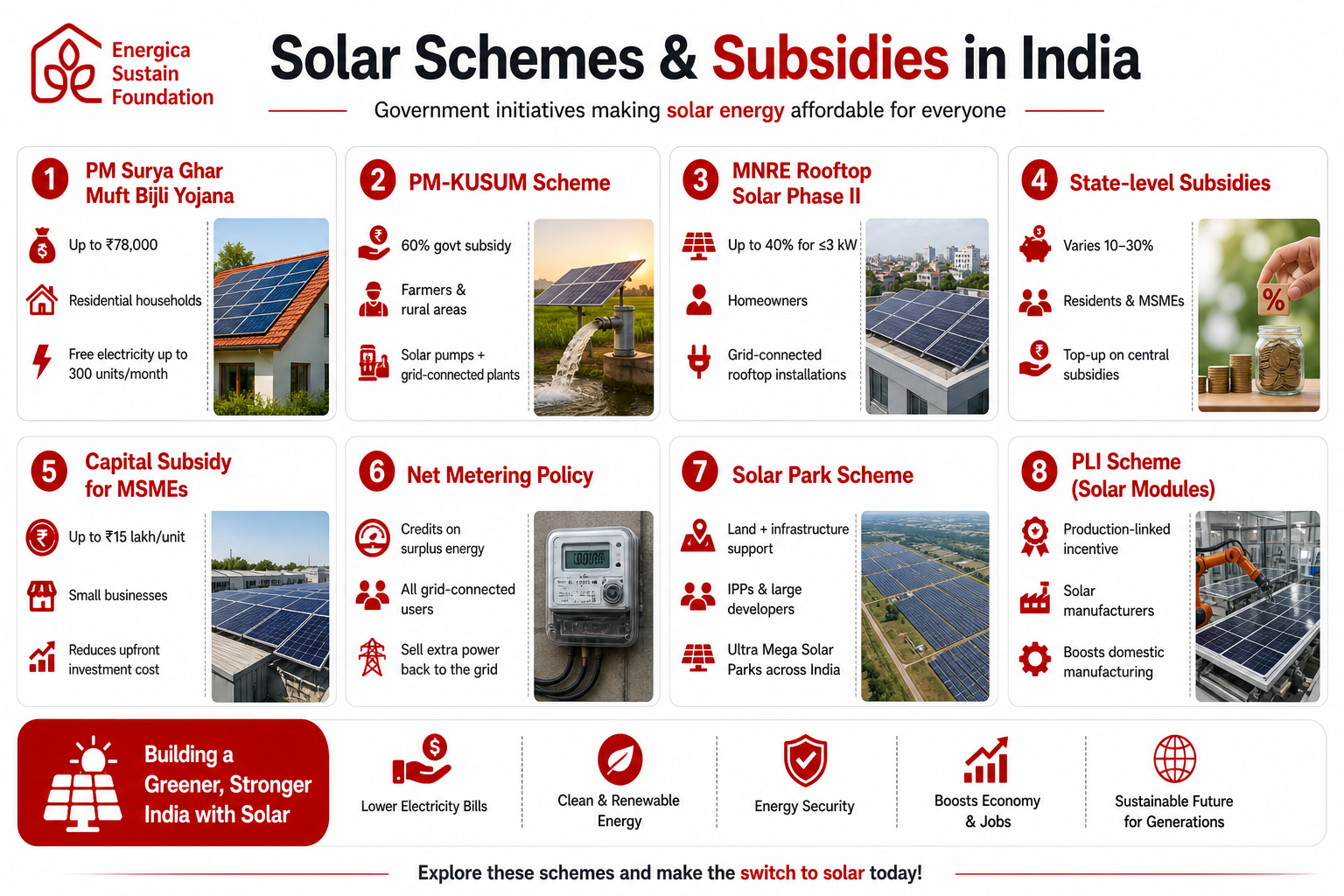
Government subsidies are playing a crucial role in making solar energy more accessible and affordable across India. By offering financial support such as upfront capital subsidies, tax benefits, and performance-based incentives, the government significantly reduces the initial investment required for installing solar systems.
Schemes for homeowners, farmers, and businesses—like rooftop solar programs, solar pump initiatives, and MSME subsidies—ensure that clean energy adoption is not limited to large players but reaches every segment of society. Additionally, policies like net metering allow users to earn credits for excess power, further improving savings. Together, these initiatives are accelerating solar adoption, lowering electricity costs, and driving India toward a more sustainable and energy-secure future.
1. PM Surya Ghar Muft Bijli Yojana — The Game Changer
Launched in 2024, this is India's most ambitious rooftop solar scheme. The goal: give 1 crore households free electricity up to 300 units per month.
- Up to ₹78,000 subsidy for systems above 3 kW
- ₹30,000 subsidy for 1 kW systems
- Net metering — sell surplus power back to the grid
- Easy online application via the national portal
For anyone exploring a solar franchise opportunity, this scheme is a dream. Demand practically sells itself when customers learn they can get near-free electricity.
2. PM-KUSUM — Empowering Farmers with Solar
Pradhan Mantri Kisan Urja Suraksha evam Utthaan Mahabhiyan targets India's farming communities. It lets farmers install solar pumps and even sell surplus energy to the grid.
- 60% government subsidy on solar pumps
- Farmers earn additional income by selling electricity
- Component A: 10 MW solar plants on barren/agricultural land
- Component B: Standalone solar-powered agriculture pumps
- Component C: Solarisation of grid-connected pumps
For a solar channel partner program operating in rural areas, PM-KUSUM is a massive opportunity. Farmers want to cut diesel costs — your partnership solves that directly.
3. MNRE Rooftop Solar Phase II — For Every Homeowner
The Ministry of New and Renewable Energy offers direct subsidies for residential rooftop installations:
- 40% subsidy for systems up to 3 kW
- 20% subsidy for systems between 3–10 kW
- No subsidy above 10 kW (but net metering still applies)
- Subsidy disbursed directly to the customer's bank account
This is the backbone of any solar business without an investment model. When the customer's subsidy covers 40% of the project cost, the deal closes itself.
4. Net Metering — Your Solar Panel Pays You Back
Net metering isn't a subsidy, but it makes your solar investment genuinely profitable. Here's how it works:
- Your panels generate electricity during daylight hours
- Excess units are automatically exported to the grid
- You receive credits for every unit exported
- Credits offset your future electricity bills month after month
Turn Subsidies Into a Solar Business Opportunity
Government subsidies don't just help customers — they create a massive solar business opportunity for entrepreneurs, agents, and channel partners.
- Solar Franchise Opportunity: Join an established solar brand and sell under their license with full backend support.
- Solar Channel Partner Program: Earn commissions by referring and closing solar deals in your territory.
- Solar Business Without Investment: Work as a consultant or agent with zero upfront capital required.
- Profitable Solar Business: Installation businesses today see 20–30% gross profit margins.
The solar industry in India is growing at 20–25% annually. Demand isn't slowing — it's accelerating. This is the best time to get in.
Frequently Asked Questions
Who is eligible for the PM Surya Ghar Muft Bijli Yojana subsidy?
Any residential household in India can get this subsidy. You can apply through the portal. You need to get an empanelled installer to do the work. The subsidy is given directly to your bank account after inspection. There is no income cap. Any homeowner can apply.
Can I start a solar business without any investment using these subsidies?
Yes, you can start a business without any investment. Many solar channel partner programmes and solar franchise opportunities allow you to work as a referral or distribution agent. You can earn commissions on every installation. The subsidy helps the customer with the financing.
Is PM-KUSUM only for farmers, or can solar businesses participate too?
No, PM-KUSUM is not only for farmers. Solar businesses can also participate as empaneled installation partners. They can earn contracts and commissions by installing systems for eligible beneficiaries.
How does a solar channel partner program work with government subsidies?
A solar channel partner acts as a bridge between the company and the customer. They help the customer apply for the subsidy, install the system, and do the paperwork. The partner earns a commission from the company.
Conclusion
The government subsidies have changed the industry in India. Solar energy is no longer a luxury; it is an income-generating investment. The barriers to adoption are lower than ever, creating a significant opportunity for solar businesses. Whether you are a homeowner, farmer, or entrepreneur, the government is already funding part of your journey.
The subsidies are live. The demand is high. The time to go solar is right now.